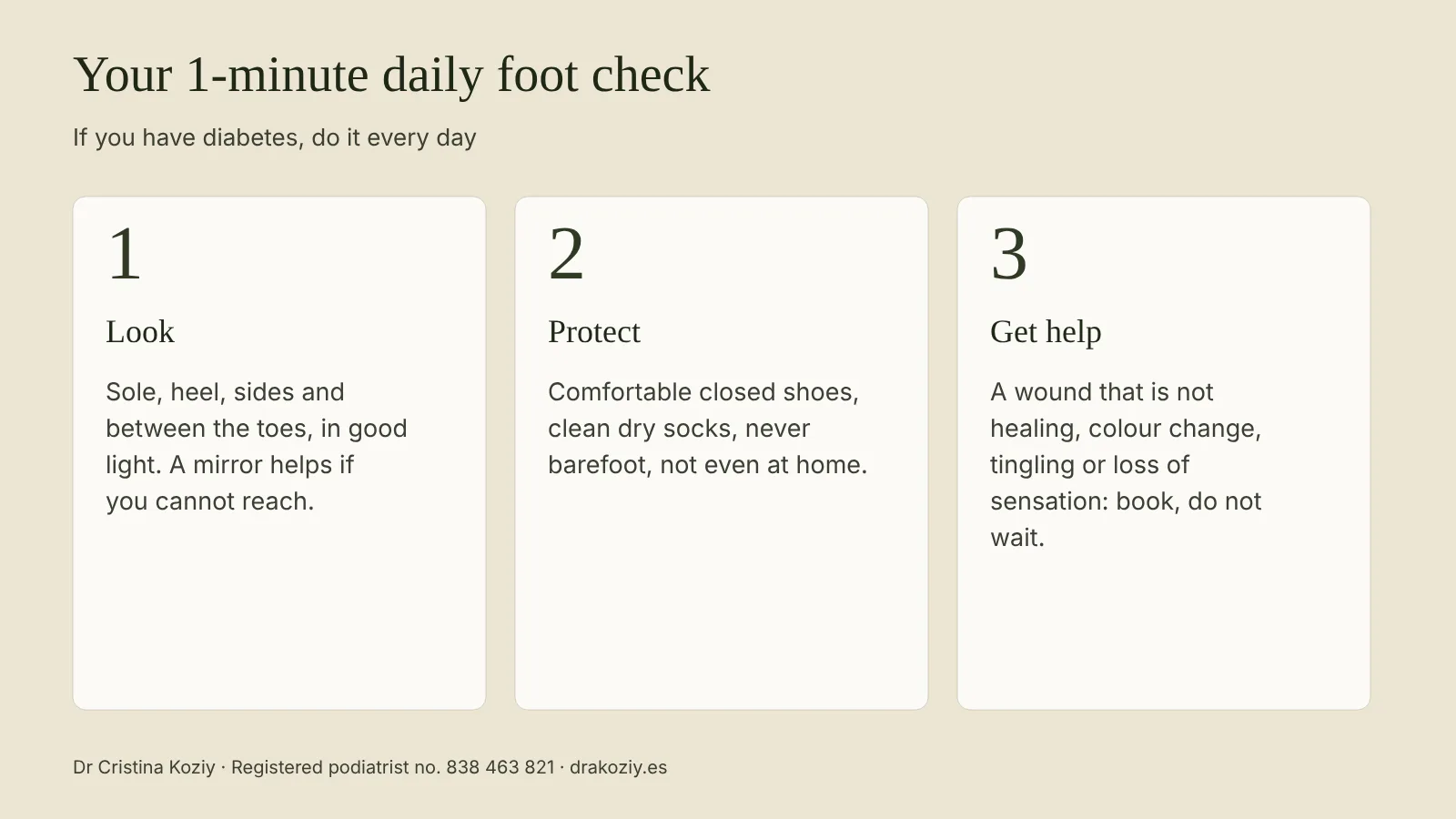
I’m Cristina Koziy, a registered podiatrist (COPCV no. 838 463 821) and a graduate of the Catholic University of Valencia. Diabetic foot care comes down to three habits: look at your feet every day, protect them with suitable shoes and socks, and get any change checked early rather than waiting for it to pass. In this article I explain how to do that, what to avoid, and when to see a podiatrist without waiting.
Everything below is general guidance and does not replace an in-person examination. It matters most for older adults and for anyone living with diabetes, because feet can lose sensation and a small injury can go unnoticed.
Why diabetes means your feet need extra attention
When blood glucose stays high for a long time, the nerves and circulation in the feet can be affected. Diabetic neuropathy in the feet (nerve damage) dulls your sense of pain, heat and rubbing. Reduced circulation means wounds can take longer to heal.
The practical result is simple: a blister, a rubbing shoe or a crack in the skin may not hurt and can still get worse. That is why prevention and regular checks are the heart of diabetic foot care, rather than treating a problem once it is already advanced.
Diabetic foot care: your daily routine
Do a daily foot check
Take a minute, in good light, to look at the tops, sides, soles, heels and between the toes. If you can’t see them well, ask someone you trust or use a mirror. MedlinePlus advises looking for dry or cracked skin, blisters, sores, cuts, redness, warmth, swelling and firm spots. The NHS adds hard skin and colour changes to that list.
Wash and dry carefully
- Wash your feet daily with lukewarm water and mild soap. Test the temperature with your hand or elbow, because with reduced sensation water that is too hot can go unnoticed.
- Dry gently, especially between the toes.
- Moisturise dry skin, but keep cream away from the skin between the toes.
Shoes and socks for diabetics
- Choose shoes that are comfortable from the first day, with room for your toes. Don’t buy tight shoes hoping they will stretch.
- Before putting them on, run your hand inside to check for small stones or seams that rub.
- Break new shoes in gradually: MedlinePlus suggests starting with one to two hours a day.
- Wear clean, dry socks every day, without thick seams or tight elastic. The Clínica Universidad de Navarra recommends natural fibres and light colours, which make it easier to spot any trace of blood or discharge.
Cutting toenails with diabetes
If you see well and your feet have normal sensation, you can trim your nails straight across, without rounding the corners, after softening them in lukewarm water. If your nails are thick or discoloured, your eyesight is limited or you have lost sensation, it is better to have a podiatrist do it. I explain the straight cut in more detail in my article on the ingrown toenail.
What never to do with a diabetic foot
- Don’t walk barefoot, at home, on the beach or by the pool. A hot surface or a small object can injure your foot without you noticing.
- Don’t use hot water bottles or electric blankets, and don’t sit too close to heaters to warm your feet: with reduced sensation a burn is easy to get.
- Don’t use corn removers, acids or medicated pads on calluses and corns. They are not designed for this situation and can damage the surrounding skin.
- Don’t cut calluses, corns or the edge of an ingrown nail yourself with scissors, blades or nippers.
- Don’t treat a wound with home remedies or leave it to see how it goes.
- Avoid smoking if you can: tobacco reduces blood flow to the feet.
Calluses and corns are usually best treated by a podiatrist. You can see how I work in medical pedicure (quiropodia). Spain’s national council of podiatrists (CGCOP) also publishes information material for patients with diabetes (in Spanish).
Diabetic foot symptoms you shouldn’t ignore
If you have diabetes, are older or have circulation problems, don’t wait for discomfort to pass on its own. This table summarises what to watch for and what to do. It is a guide, not a diagnosis.
| What you notice | What to do |
|---|---|
| A wound, blister or crack that doesn’t improve within a few days | Book with a podiatrist or your doctor as soon as possible. Don’t treat it yourself. |
| Redness, warmth or swelling in the foot or ankle | Get it checked soon, even if it doesn’t hurt. |
| A change in colour (reddish, pale or bluish), or one foot clearly colder or warmer than the other | Get it checked soon: it may be related to circulation. |
| Tingling, burning, numbness or loss of sensation | Mention it at your appointment: reduced sensation is what allows injuries to go unnoticed. |
| An ingrown or very thick toenail | Don’t work on it yourself; book an appointment. |
| Pus, bad smell, fever, feeling generally unwell, or redness that spreads | Don’t wait for a routine visit: see your doctor or go to urgent care the same day. |
When should you see a podiatrist if you have diabetes?
The best time is before a problem appears. MedlinePlus says a professional should examine your feet at least once a year, and every three to six months if you have already had an ulcer. In my practice I usually recommend a check-up every two months, adjusted to your level of risk. In practice, how often depends on your level of risk, and that is decided after an examination.
Book without waiting for your scheduled check if:
- you notice anything in the table above;
- you have calluses, corns or thick nails and aren’t sure how to manage them safely;
- your shoes rub or your foot is changing shape;
- you can’t check your own feet.
How I approach the diabetic foot in the clinic
In my clinic the aim is prevention: spotting in good time what you can’t see or feel. An assessment usually includes:
- Vascular assessment: pulses, skin temperature and colour, with Doppler equipment.
- Neurological assessment: tests of sensitivity to touch, temperature and pressure.
- Skin and nail review: calluses, cracks, fungus, wounds, and thick or ingrown nails.
- Footwear and gait: where pressure builds up and where the shoe rubs. Where appropriate, I assess custom insoles.
I also show you how to check your feet at home. If getting around is difficult, I offer home visits in Valencia and the surrounding area. Everything I offer for people with diabetes is on the diabetic foot care in Valencia page.
Everyday foot care for diabetics: one last tip
Diabetic foot care doesn’t need to be perfect: consistency is what counts. Looking at your feet every evening, wearing the right shoes and getting checked in good time helps prevent many problems. If you’re unsure, ask: a visit that turns out to be unnecessary is better than a wound left unattended. To book, you can write to me through the contact page.
Frequently asked questions
Check them every day, wash with lukewarm water and mild soap, dry carefully between the toes, moisturise dry skin and wear comfortable shoes with clean socks. Avoid walking barefoot and get any change checked without waiting. This is general guidance and does not replace an examination.
The most common signs are tingling, burning or loss of sensation, wounds or blisters that heal slowly, colour changes, swelling, redness and warmth. Sometimes there is no pain at all. If you notice any of these, get checked soon: only an examination can say what is going on.
In my practice I usually recommend a check-up every two months, adjusted to your level of risk after an examination. As a guide, MedlinePlus says at least once a year, and every three to six months if you have had an ulcer. Book sooner for a wound that isn’t improving, a colour change or loss of sensation; for pus, fever or spreading redness, see your doctor the same day.
You can if you see well and still have normal sensation: after softening them in lukewarm water, trim straight across without rounding the corners. If your nails are thick or discoloured, your eyesight is limited or sensation is reduced, it is better to have a podiatrist do it.
Shoes that are comfortable from day one, with room for the toes and no seams that rub, plus clean, dry socks without tight elastic. Break new shoes in gradually and check inside with your hand before putting them on. A podiatrist can assess your individual case.
Because acids and blades can damage healthy skin, and with reduced sensation an injury may go unnoticed. MedlinePlus advises having calluses treated by a podiatrist and avoiding medicated pads or cutting them at home.
Sources
- MedlinePlus: Diabetes foot care
- MedlinePlus: Diabetes tests and checkups
- Mersey Care NHS Foundation Trust: Diabetes and foot care
- Clínica Universidad de Navarra (in Spanish): Cómo debe cuidar sus pies una persona con diabetes
- CGCOP, General Council of Podiatrists of Spain (in Spanish): patient material on the diabetic foot
Dra. Koziy · Podiatry
Clinic: Centro Médico Almenara, Carrer de la Serra d’Espadà 4, 12590 Almenara (Castellón). Home visits across Valencia and the metropolitan area.
Tel. 962 62 34 46 · WhatsApp +34 633 300 297
More about the treatment: diabetic foot care in Valencia: assessment and prevention.