I’m Cristina Koziy, a registered podiatrist (licence no. 838 463 821) and a graduate of the Catholic University of Valencia. Ingrown toenails are among the most common problems I see, both at Centro Médico Almenara and on home visits in Valencia. In this article I explain what an ingrown toenail actually is, what you can safely do at home, what you should never do, and when it’s time to have a podiatrist look at it.
What an ingrown toenail is
An ingrown toenail (onychocryptosis) happens when the side edge of the nail grows into the skin beside it. It’s almost always the big toe, though any toe can be affected. The skin responds with pain, redness and swelling. If the edge stays embedded, the area can become infected, with pus or soft, red tissue that bleeds easily.
It isn’t a serious condition in itself, but it tends to get worse when ignored or when people try to fix it at home with scissors or clippers. That’s why early attention matters.
Why it happens
The most common causes I see in clinic:
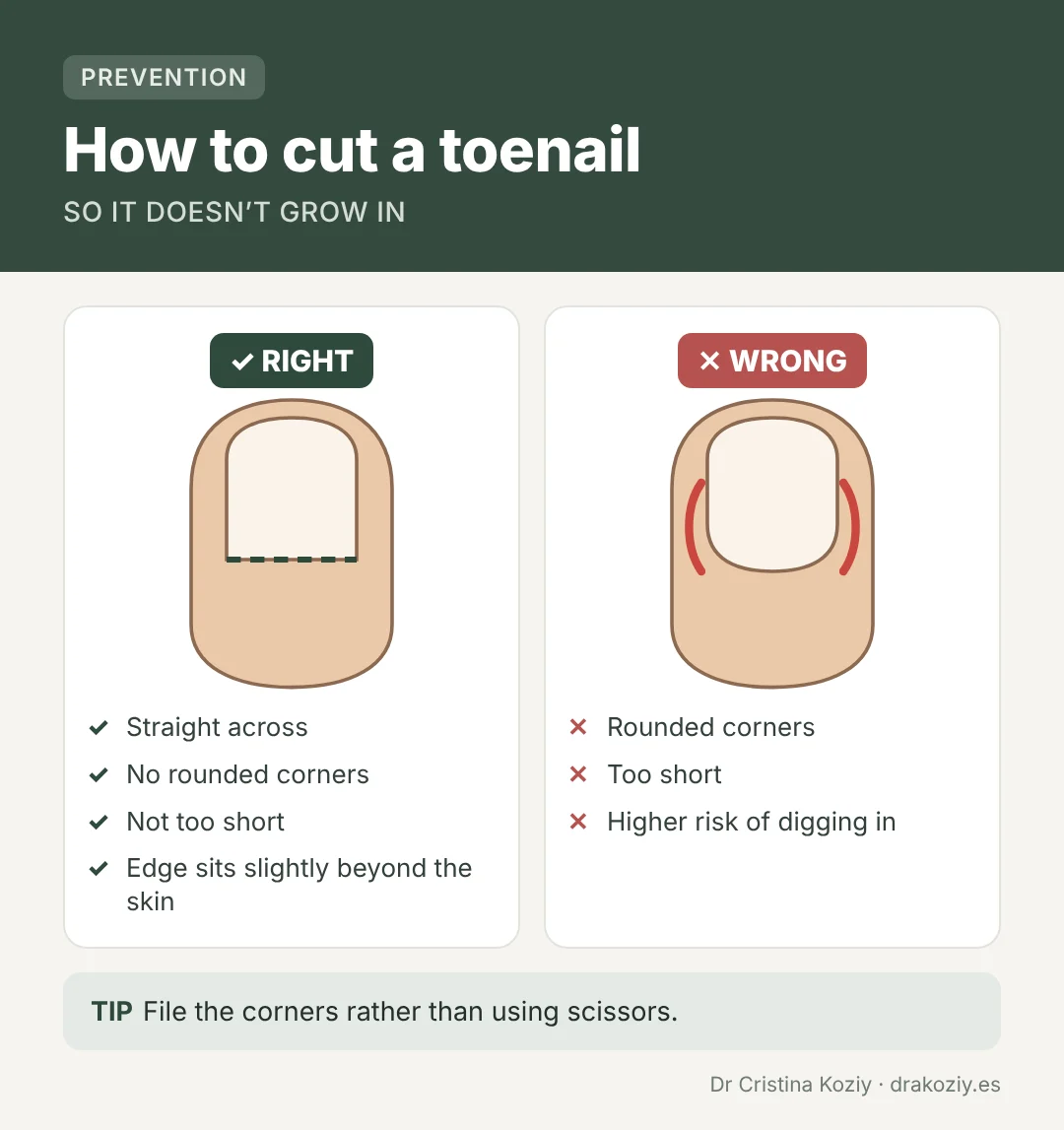
- Cutting the nail incorrectly. Too short, or with rounded corners, leaves an edge that digs into the skin as it grows.
- Narrow or pointed shoes. Constant sideways pressure pushes the skin against the nail.
- Nail or toe shape. Some nails are naturally more curved and more prone to growing in.
- Impact sports. Football, running, anything with repeated knocks against the toe box.
- Sweat and moisture. Softened skin gives way more easily.
- A previous injury to the toe, such as being stepped on or stubbing it.
Knowing the cause matters: if it isn’t corrected, the problem can come back even after proper treatment.
What you can do at home (and what you can’t)
If the discomfort has only just started, the pain is mild, there’s a little redness and no pus, these steps usually help settle the area while you book an appointment:
- Wash the foot with warm water and mild soap once or twice a day. Dry it well, especially between the toes.
- Wear wide or open shoes for a few days to take pressure off the toe.
- Don’t squeeze, pierce or try to “drain” the area.
- If you have diabetes, circulation problems or take blood thinners, don’t wait to see how it develops: book as soon as you can.
What not to do, and I say this because I see it every week:
- Don’t cut the embedded edge with scissors, clippers or nippers. It’s very easy to leave a spicule (a fragment of nail hidden under the skin) that makes the inflammation worse.
- Don’t push cotton, dental floss or other objects under the nail.
- Don’t apply corn removers or acids: they’re meant for hard skin, not an open wound.
- Don’t take antibiotics without professional advice.
These are general guidelines and don’t replace an in-person assessment. A painful toe may be an ingrown nail, but it may be something else, and that can only be told by examining it.
When to see a podiatrist
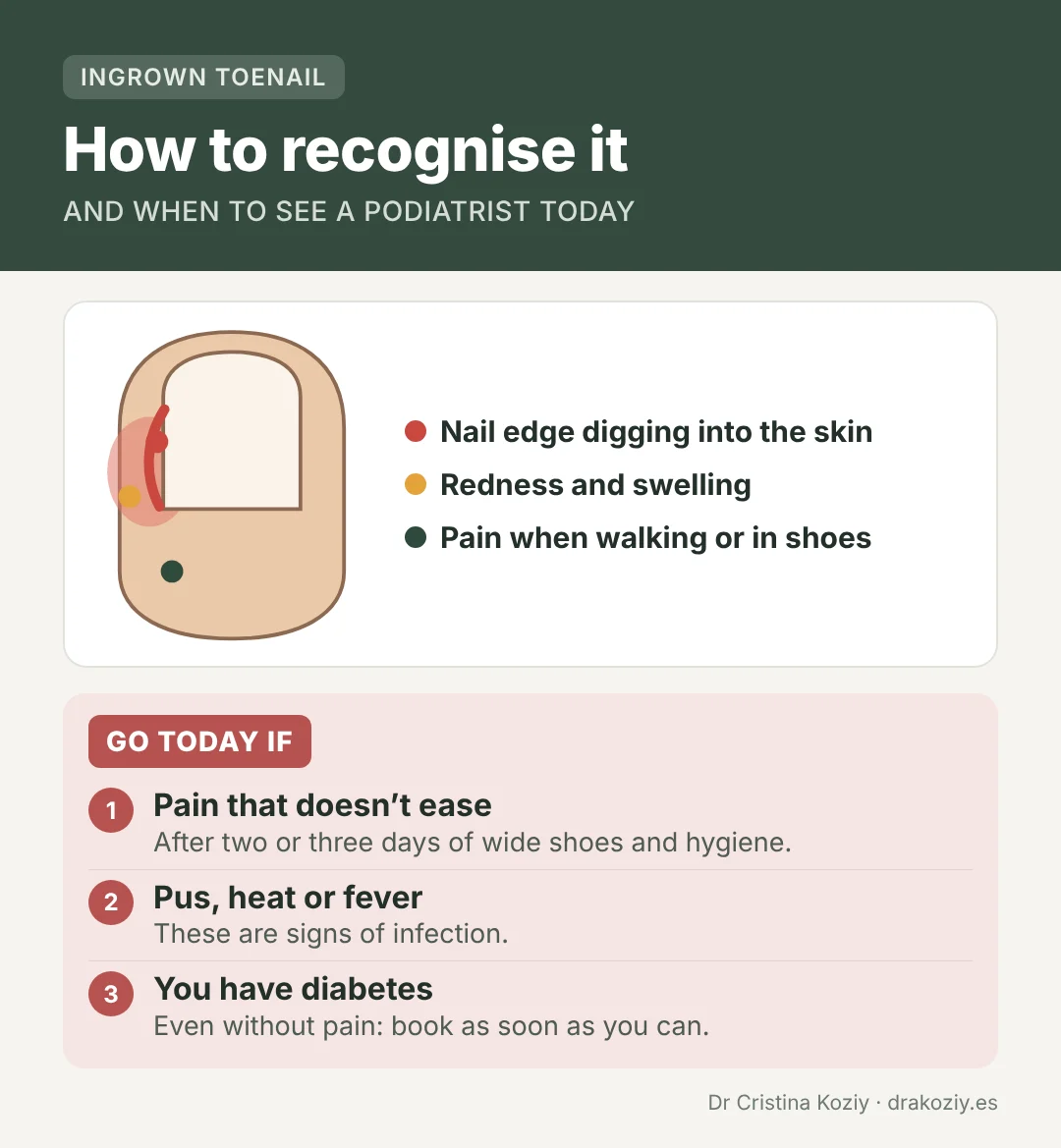
Book an appointment if (and make sure it is a registered podiatrist: you can check in the Valencian College of Podiatry directory):
- the pain doesn’t improve within two or three days of the measures above,
- there’s pus, heat, spreading swelling or fever,
- the nail grows in repeatedly, even if the current episode is mild,
- you have diabetes, even without pain (sensation in the foot may be reduced and damage can progress unnoticed; the Spanish General Council of Podiatrists explains why the diabetic foot needs professional checks),
- it’s a child or teenager: it’s very common at this age, and treating it properly early stops it becoming a recurring problem.
How I treat it in clinic
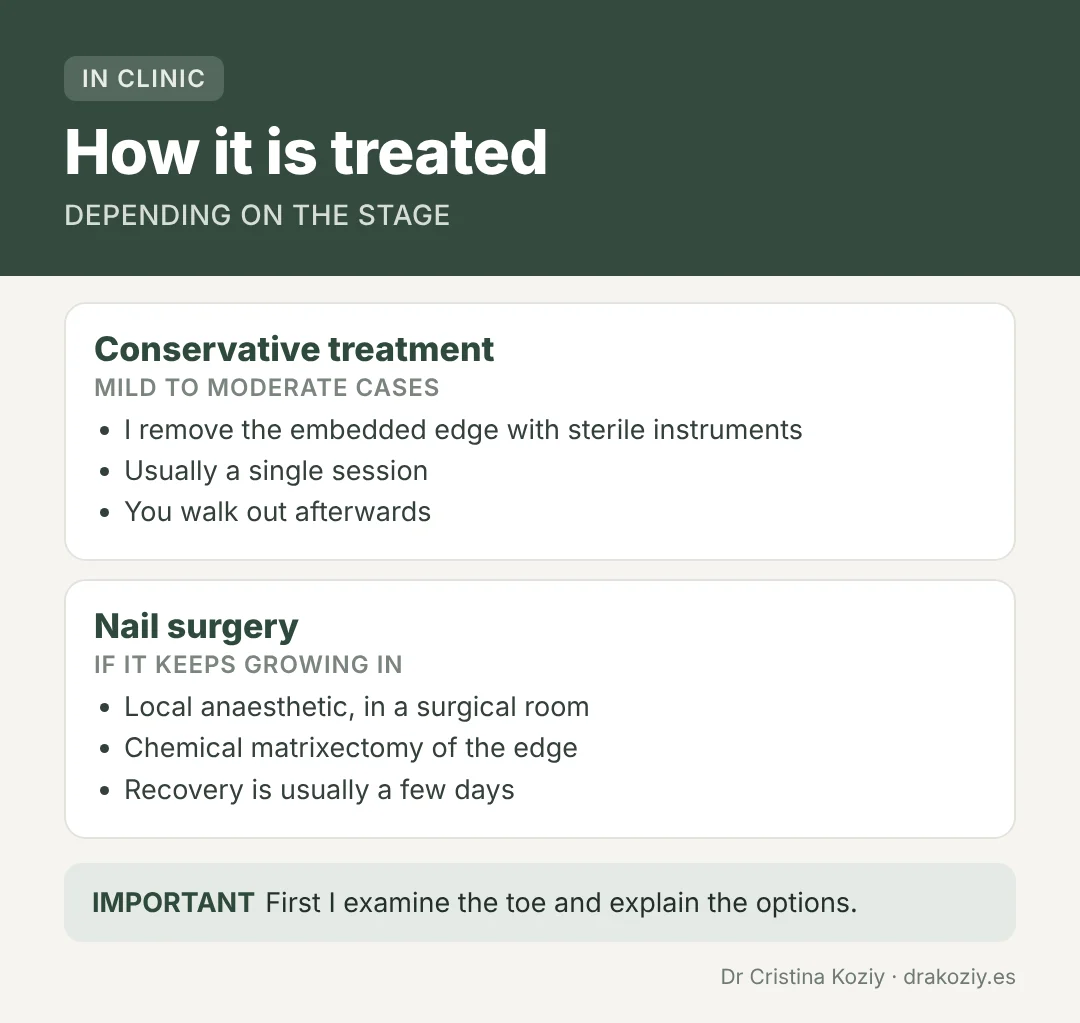
Treatment depends on the stage the nail is at. At the first visit I examine the toe, check for infection and explain the options.
Conservative treatment. In mild to moderate cases, I remove the embedded edge of the nail with sterile instruments, clean the area and show you how to cut the nail from now on. It’s usually a single session and you walk out afterwards.
Nail surgery with chemical matrixectomy. When the nail keeps growing in, or the edge is deeply embedded, the usual option is a minor procedure under local anaesthetic in the toe itself. The side portion of the nail is removed and the matrix (the root of that edge) is treated with a chemical agent so that part doesn’t grow back. It is minor surgery: it is done under local anaesthetic in a dedicated podiatric surgical room, not in the usual consultation room. The procedure itself takes a few minutes (with preparation and dressing, the appointment can last up to about 45 minutes), no hospital admission is needed, and recovery is usually a few days with simple dressings at home. As with any procedure, there’s a small chance of recurrence or of discomfort during healing; I discuss this with every patient before deciding.
For patients with diabetes or circulation problems, dressings and follow-up are closer. You can read more on the diabetic foot page.
How to stop it coming back
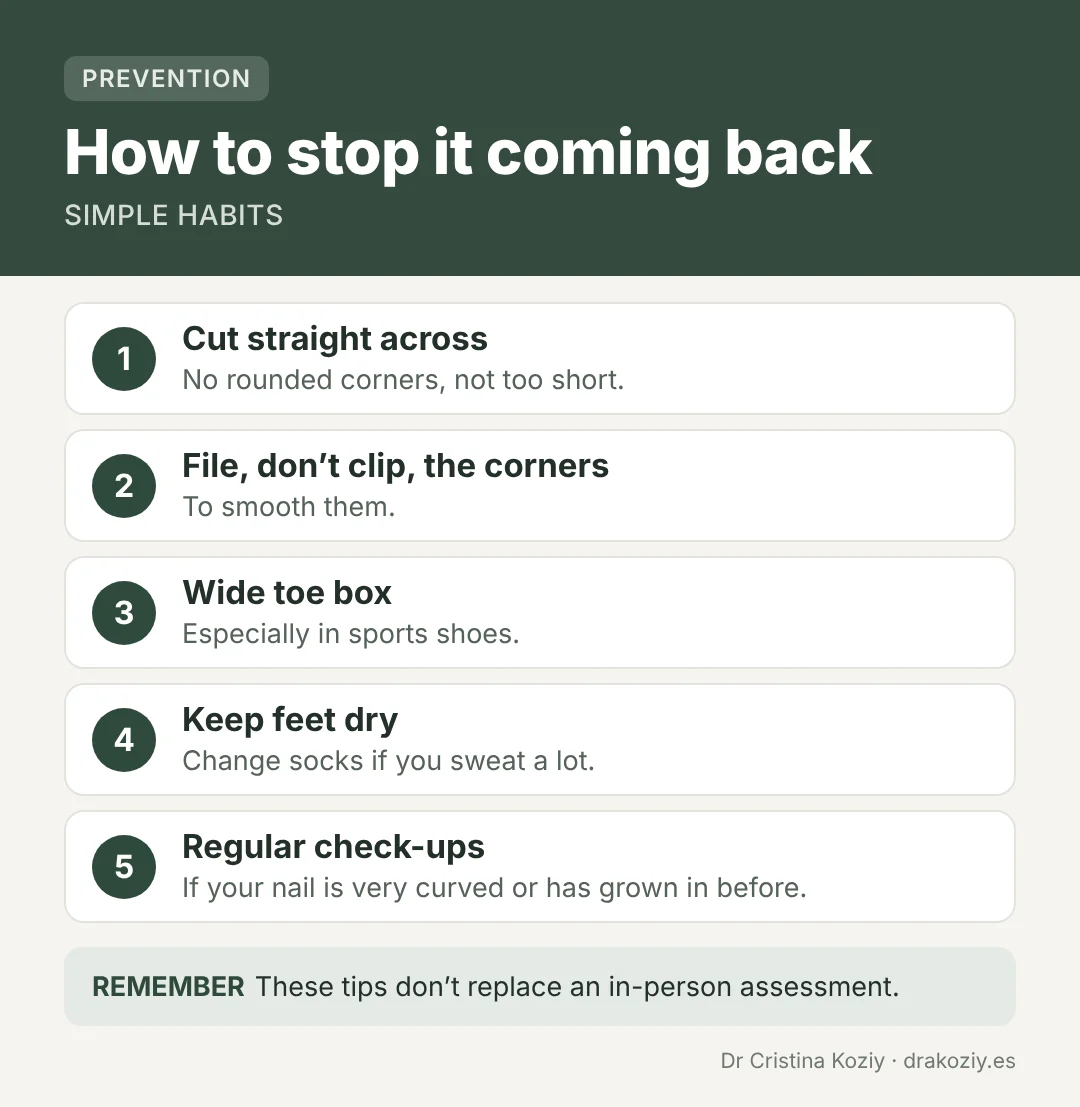
- Cut the nail straight across, without rounding the corners, and not too short: the edge should sit slightly beyond the skin.
- Use a file rather than scissors for the corners.
- Choose shoes with a wide toe box, especially for sport.
- Keep your feet dry and change socks if you sweat a lot.
- If your nail is very curved or you’ve had this before, a periodic check with a podiatrist lets us act before it hurts.
Frequently asked questions
In the very early stages, with wide shoes and good hygiene, the discomfort may go away. Once the edge is embedded or there’s inflammation, it usually won’t resolve without removing that fragment of nail.
Conservative removal is well tolerated in most cases. Nail surgery is done under local anaesthetic, so there’s no pain during the procedure; afterwards there may be mild discomfort, managed with ordinary painkillers.
Most patients are back to normal activity within a few days, with simple dressings at home and comfortable footwear. The exact time depends on the person and on whether there was infection beforehand.
After a chemical matrixectomy, recurrence is uncommon but possible. Cutting the nail correctly and wearing suitable shoes reduces the risk.
A podiatrist is the healthcare professional who treats ingrown toenails directly, including nail surgery. If there’s fever or signs of infection spreading across the foot, see a doctor without delay.
Sources
- General Council of Official Colleges of Podiatrists of Spain (CGCOP): diabetic foot
- Official College of Podiatry of the Valencian Community: patient information and registered podiatrist directory
Dra. Koziy · Podiatry
Clinic: Centro Médico Almenara, Carrer de la Serra d’Espadà 4, 12590 Almenara (Castellón). Home visits across Valencia and the metropolitan area.
Tel. 962 62 34 46 · WhatsApp +34 633 300 297
More about the treatment: Ingrown toenail surgery in Valencia.